


What really goes into creating a bespoke ring? From hand-drawn designs and raw precious metal to precision bench work, discover how bespoke jewellery is created by a goldsmith.
Back to Works in Progress.jpg)
A bespoke ring usually starts with a conversation.
Then, if I am completely truthful, I think ummmmmm.
I make a coffee, wander around the garden and think about what we talked about.
Not necessarily every detail. Usually it is the first thing you said to me that stays. That first piece of information is often the most important. From there, shapes begin to form in my mind.
Once they do, I go back inside and reach for a pencil.
My designs are still drawn by hand. Very old school, but it is the way I was trained and I enjoy the process.
At first, it is effectively doodling. I let shapes develop on the page until something clicks into place.
That click is when the goldsmith part of my brain takes over.
I begin drawing at 1:1 scale, because now the idea has to work. I need to know exactly how large the gemstones are, how the metal needs to form around them, where that metal needs to be for strength and security, and how everything will sit together on the hand.
It has to look sensational, but it also has to function as a piece of jewellery.
Sometimes a client arrives with a very clear brief. Sometimes there is barely a brief at all.
In those cases, I build one from our conversation.
It might come from something mentioned almost in passing. A preference, a feeling, the way someone describes another piece of jewellery, or a tiny detail they probably did not realise was important.
Those little things have a habit of finding their way into the design.
There is instinct involved too. When someone cannot quite describe what they want, I explore what feels natural to them and to the conversation we shared.
Then I work out how to make it.
I will often create three concepts for a bespoke piece.
The first is usually where my instincts take me. The others are a test.
Is there something I missed in the first design? Could another direction work even better? Is there a possibility worth exploring before we commit?
They also give my clients a chance to see whether what I have drawn matches what they had pictured in their own minds.
Sometimes one of those designs is a complete wildcard.
The point is not to create options for the sake of it. It is to make sure we have explored the possibilities properly before precious metal is cut and shaped.
For someone who has made the conscious decision to come to my studio and have something created especially for them, I think that care matters.
Once the design is approved, I start planning how I am actually going to make it.
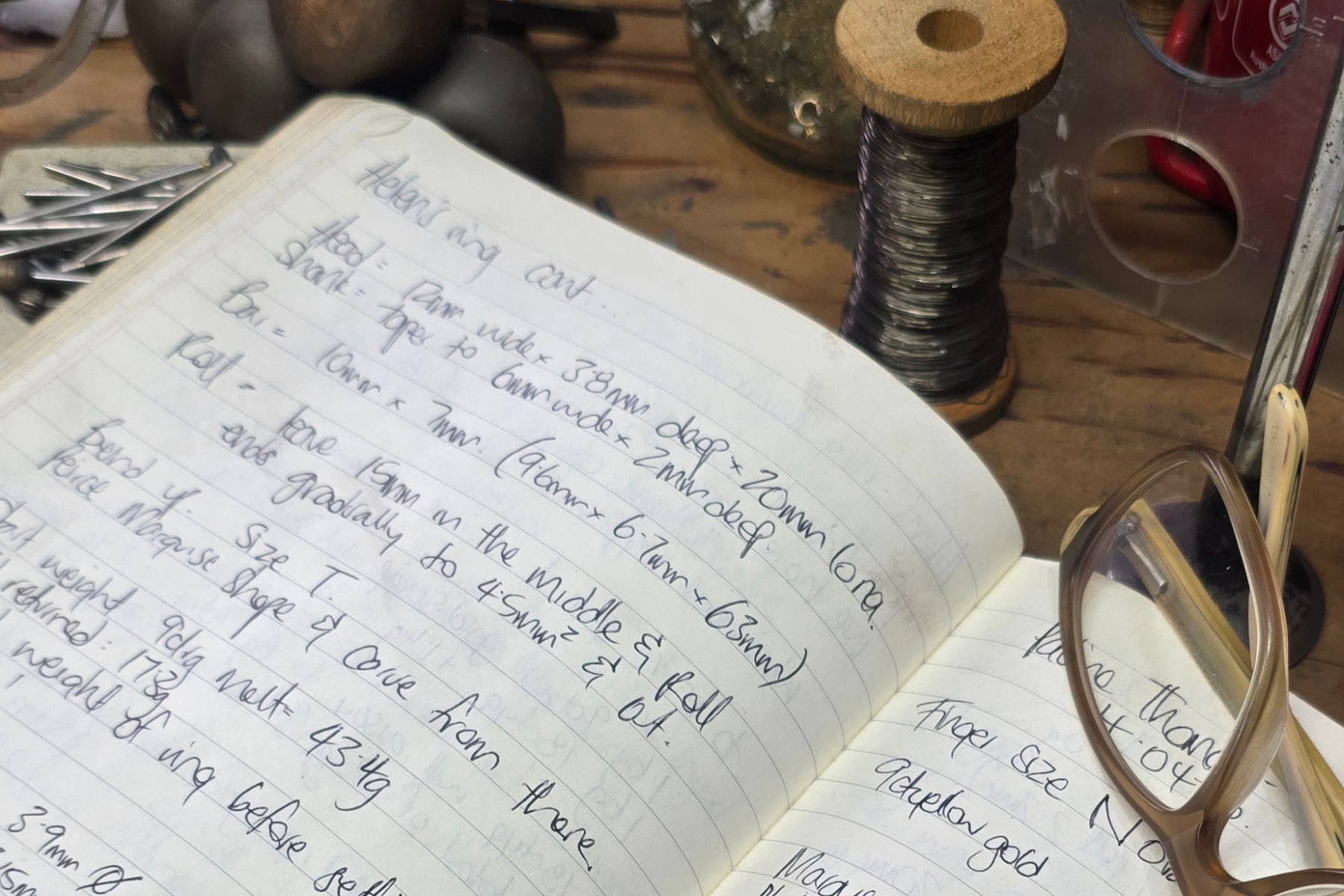
On my bench is a little diary I named Trade Secrets. I have kept a book like this beside me since my first days at the bench.
Inside it, I write what I call the recipe.
Every measurement I will need goes into it.
A piece of precious metal might begin as a 6.2 mm square bar. From there I calculate how that bar needs to be rolled, compressed, annealed, bent and formed to create each part of the ring.
The shank may need one dimension through the back and another where it meets the setting. Wire may need to be made. Settings need to be constructed specifically for the gemstones. If I am working with a client's existing gold, that may need to be melted and prepared first.
I work the whole sequence out before I begin.
It gives me a road map to the finished piece.
Once the skeleton of the process is solved on paper, I can concentrate completely on what happens at the bench.
For most of my bespoke work, I do not begin with a finished computer model or send a design away to be cast.
Around 95% of my CPGS pieces are made directly at the bench using traditional goldsmithing techniques.
Metal is rolled down to precise dimensions, checked, annealed, formed and checked again.
You do not want to roll too far. Trust me.
Once the basic material is prepared, the concentration changes.
Now we are working in tenths of a millimetre. Joints need to be so precise that light will not pass through them. Settings need to be made for the actual gemstone that will live inside them.
No square pegs in round holes over here.
Everything is made to fit.
This is the part of goldsmithing I find particularly interesting.
There is engineering happening constantly.
Is the structure strong enough? Is the setting secure? Is there enough metal exactly where it needs to be? Will the ring withstand the life it is being made for?
But at the same time there is another conversation going on.
Would a little more curve give the design beautiful movement, or take it too far? Would removing the tiniest amount of metal improve the balance? Could softening this point make the ring more comfortable on my client's hand?
Those decisions can be fractions of a millimetre.
That is the connection between head, heart and hands.
The technical thinking has to be right, but so does the feeling of the piece.
I am thinking about the person who will wear it throughout the process. The ring has to work mechanically, but it also has to feel like theirs.
This might be one of the hardest questions in the entire process.
Experience teaches you when to stop.
There is a point somewhere between not quite enough and one step too far, and continuing to work past it can begin to undo what made the piece feel right in the first place.
Restraint matters.
So does self-checking.
Eventually, there is a moment when I know.
That is it.
Once the gemstones are set, the final polish is complete and the ring is finished, I do not try it on.
I may test and try a piece throughout the making process, but once it is completely finished, that changes.
That first proper try-on belongs to my client.
To me, that is a special moment, and one I want to leave entirely for them.
Am I nervous when they finally put it on?
Every time.
By then I have spent hours thinking about them, drawing for them, calculating, forming, filing, soldering, checking, refining and making all those tiny decisions that they will probably never know were made.
I am incredibly invested in how they feel when they finally see their jewellery finished.
Perhaps that is what really goes into creating a bespoke ring.
There is the gold, the gemstones, the measurements and the tools, of course.
But there is also a conversation, a coffee, a wander around the garden, pages of pencil marks, a slightly battered book of Trade Secrets, years of learnt technique and hundreds of tiny decisions made with one person in mind.
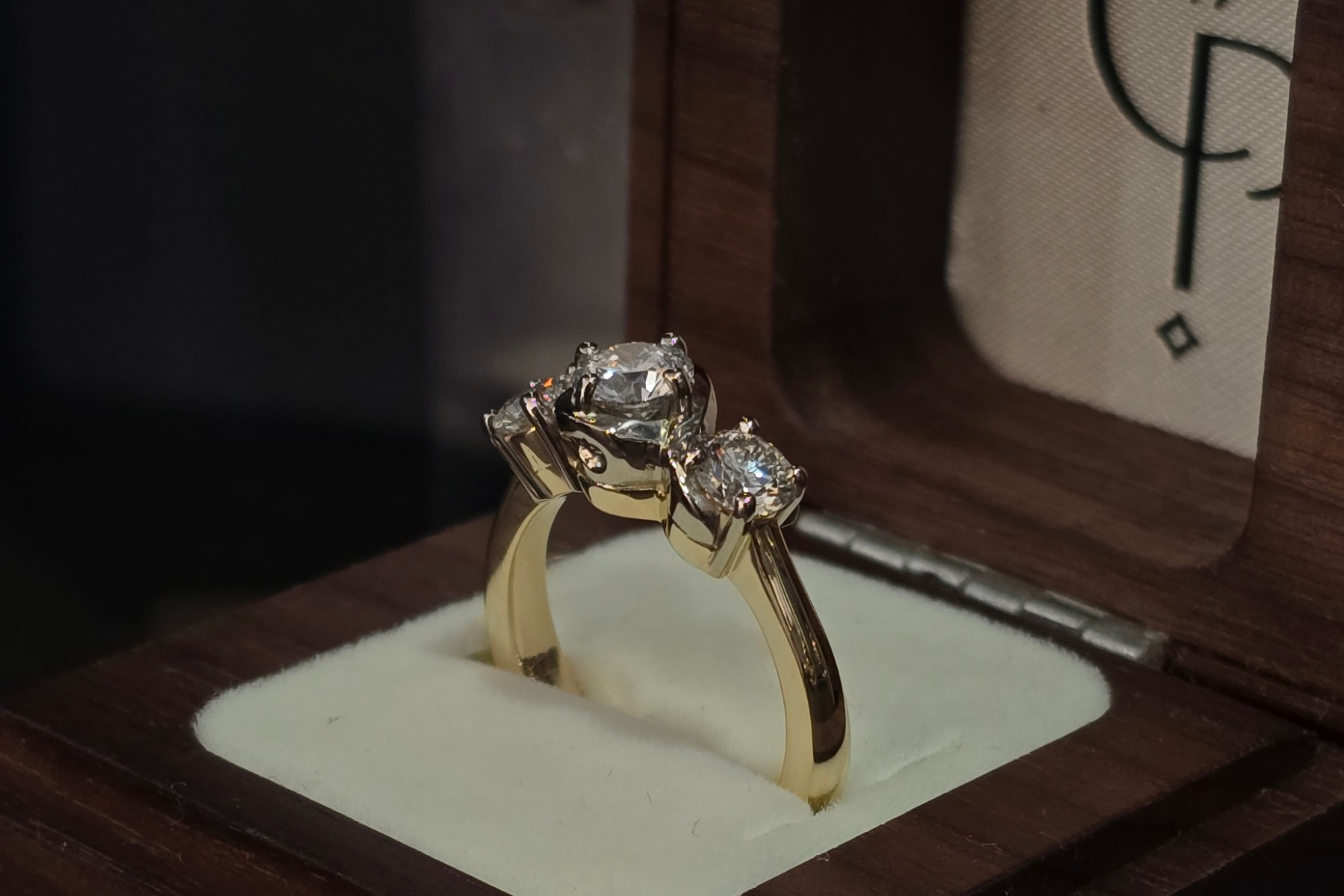
Then, eventually, there is a ring.
.jpg)
.jpg)

Discover what really happens when a jeweller sources a gemstone, from meaning and colour to trusted dealers, careful selection and bespoke jewellery design.

Discover why two sapphires can look completely different, from colour and origin to cut, light and personal gemstone selection for bespoke jewellery.

Choosing a gemstone for bespoke jewellery is about more than colour or value. Discover how gemstones are selected, sourced and matched to the person who will wear them.
When a piece of jewellery is lost or damaged, most people assume the insurance process will simply replace what they had.In reality, that is not always what happens.This is something I have seen many times over the years at the bench. Not occasionally, but consistently enough that it is worth explaining how the process works, and where people can get caught out.


The way jewellery is made matters so much. It is the difference between treasure and trend
Here are some ideas that will keep your jewellery looking it’s best